What Is This and Why Do You Care?
If you run an oil and gas company, manufacturing business, or property management firm, you've likely been hearing about AI tools that can help automate client interactions, streamline operations, and handle the repetitive tasks that eat up your team's time. Claude Opus 4.8 is the latest release from Anthropic, and it's worth your attention—not because it's the newest shiny object, but because it genuinely improves on what AI assistants can do for your business.
Opus 4.8 is Anthropic's most capable model to date. It builds on earlier versions with measurable improvements in coding, agentic skills, reasoning, and practical knowledge work. For your business, this translates to an AI that can handle more complex tasks with better judgment, fewer mistakes, and more honest assessments of its own work.
The key question: Does this matter for an oil and gas company with multiple facilities, a mid-sized manufacturer, or a property management portfolio? The answer is yes—but in specific ways that matter more for some use cases than others.
What's Actually New in Opus 4.8
The most significant change is effort control. Opus 4.8 defaults to high effort, and you can scale up from there for even deeper analysis. For quick lookups or simple responses, you can dial down—but the baseline is already substantial. For complex analysis or multi-step projects, higher effort settings like "extra" or "max" deliver deeper reasoning and better results.
This matters for your business because it gives you control over speed versus depth. Need a quick summary of a contract clause? Dial it down. Need thorough research across multiple facility inspection reports for an oil and gas compliance audit? Dial up for deeper analysis.
Dynamic workflows is another major capability. In business terms, it means Claude can handle very large, multi-step jobs across many systems in one session—coordinating analysis across dozens of maintenance reports, vendor contracts, and compliance documents without losing the thread. Under the hood, Claude Code with Opus 4.8 plans the work and runs hundreds of parallel subagents in a single session; for software teams, it can even carry out codebase-scale migrations across hundreds of thousands of lines of code from start to finish. The practical point for your business: workflows that involve multiple interconnected systems can now be handled in one coordinated pass.
Fast mode has also improved significantly. Opus 4.8's fast mode runs at 2.5× the speed of standard processing, and it's now three times cheaper than fast mode on previous Opus models. If you've been hesitant to use AI for real-time customer interactions because of speed or cost, this shift makes those use cases more viable.
Honesty and reliability see substantial improvement. Opus 4.8 is approximately four times less likely than its predecessor to allow flaws in code to pass unremarked (this metric is specific to code review). It also proactively flags uncertainties across other workflows—it's more likely to tell you when it doesn't know something rather than making up an answer. For professional workflows—legal research, compliance documentation, technical specifications—this honesty about limitations matters.
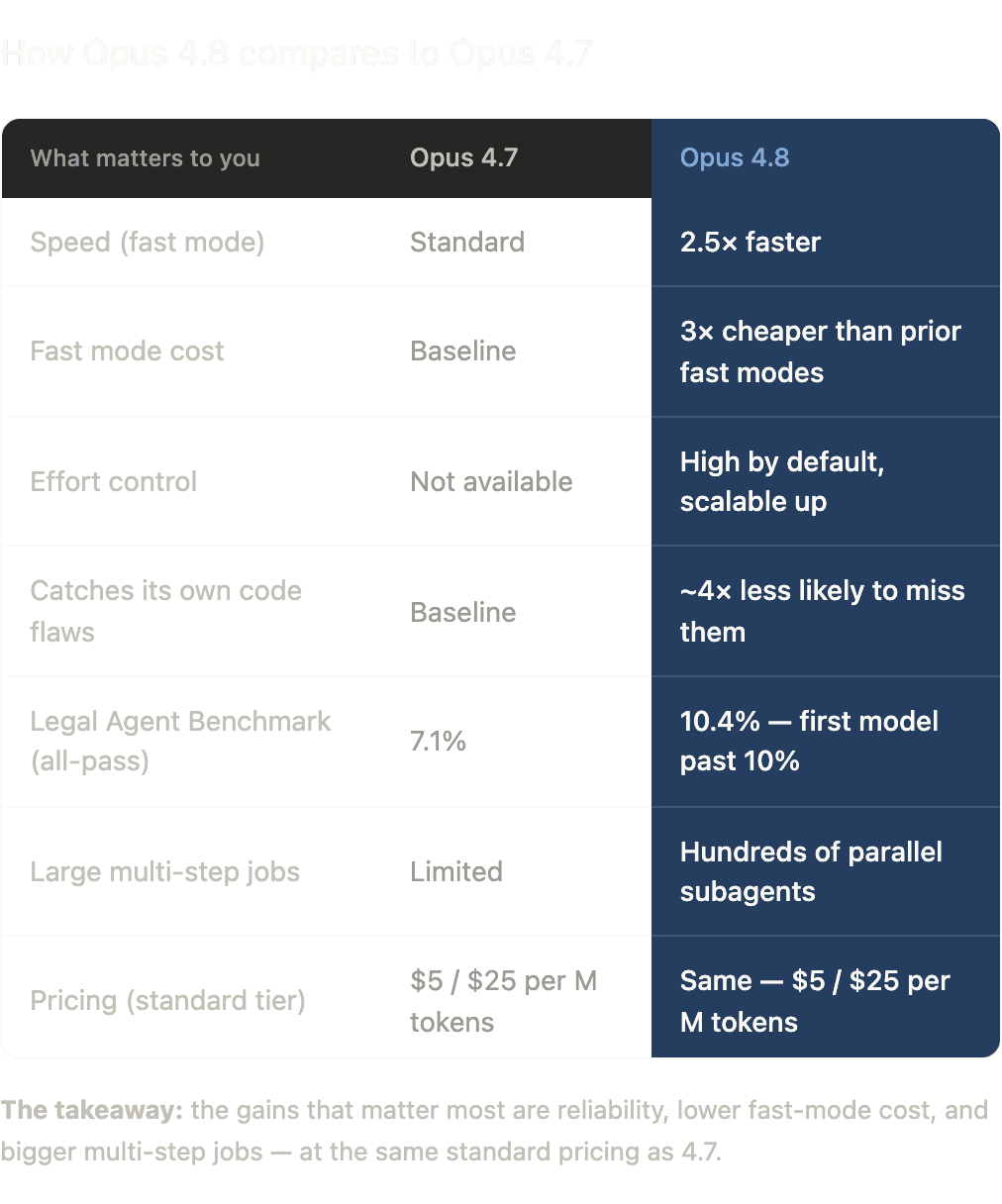
The takeaway for a business owner: the improvements that matter most aren't about raw intelligence scores—they're about reliability (it catches its own mistakes more often), cost (fast mode got cheaper), and the ability to hand it larger, multi-step work. And the standard pricing didn't move, so the gains come without a cost increase.
How These Capabilities Could Apply to Your Industry
Oil and Gas
With a 1M-token context window, Opus 4.8 can ingest entire compliance document libraries, maintenance logs, and regulatory filings in a single session. Combined with approximately 4× better flaw-catching, this could apply to:
Compliance documentation review where missing a regulatory detail carries significant penalties.
Equipment maintenance logs analysis across multiple facilities with better consistency.
Vendor and supplier analysis that pulls from lengthy contract documents and performance records.
The improved agentic tool calling means the AI could integrate with your existing maintenance and dispatch systems to automate workflows that currently require manual coordination.
Manufacturing
The combination of long context and improved reasoning could apply to:
Quality-control documentation review that catches inconsistencies across large batches of records.
Supplier communications that synthesize requirements, quotes, and delivery schedules from multiple sources.
Work-order generation that pulls from product specs, inventory systems, and labor allocation in context.
Fast mode improvements make real-time shop-floor assistance more viable—faster responses without the cost concerns that previously limited adoption.
Property Management
The model's ability to handle complex, multi-party conversations with better consistency could apply to:
Tenant inquiry handling that triages maintenance requests, lease questions, and billing issues with improved judgment.
Lease document review that identifies key terms, renewal dates, and compliance requirements across large portfolios.
Maintenance triage that prioritizes requests based on urgency, available contractors, and historical patterns.
The 1M-token context means the AI could work with years of tenant communications, property histories, and standard operating procedures in a single session—something that wasn't practical with earlier models.
The Bigger Picture
What makes Opus 4.8 notable isn't any single feature—it's the combination of improvements across reliability, speed, and cost. The model is more honest about its limitations, faster when you need speed, and cheaper to run in fast mode.
For businesses considering AI adoption, this release signals that the technology has reached a point where it can handle meaningful professional work—not just chatbots, but substantive assistance with complex tasks.
The opportunity here is straightforward: businesses that learn to work effectively with these tools could gain efficiency advantages. The key is understanding what each capability could apply to for your specific workflows.
Getting Started
If you're evaluating Opus 4.8 for your business, consider starting with:
Identify high-impact use cases: Where does your team spend time on repetitive, structured tasks?
Start small: Test with a limited scope before expanding.
Measure results: Track time saved, error rates, and quality improvements.
Iterate: Refine prompts and workflows based on real-world performance.
The businesses that benefit most are those that approach AI as a collaborative tool—something that augments their team's capabilities rather than replacing judgment entirely.